Diễn Đàn » English Club

Science

120 trả lời, 20.099 lượt xem — Trang 2 / 5
Reuters - Mon Aug 8, 3:36 AM ET
(L-R) Specialists from a British submarine rescue team Nygel Pyne, Markus Cave, David Burke and Charlie Sillett pose for a picture in front of their Scorpio underwater robot in Petropavlovsk-Kamchatsky, August 8, 2005. Rescuers cut a Russian mini-submarine free of tangled deep-sea cables on Sunday, saving its seven crew with British help, after a three-day ordeal deep in the Pacific with dwindling oxygen.
REUTERS/Pool

📎 r3357170276
Đăng nhập để trả lời
0
Mon Aug 8, 3:11 AM ET Crew members of Russian mini-submarine AS-28 'Priz' from left: Alexandre Ivanov, Sergei Belozerov, commander Vyacheslav Milashevsky, Valery Lepetuha, Anatoliy Popov, Alexandre Uibin, Alexander Boloshin pose for a picture at a hospital in Petropavlovsk-Kamchatsky, Russia Monday Aug. 8, 2005. The seven men endured darkness and frigid temperatures for three days until their Russian mini-submarine was freed from the Pacific floor by a British remote-controlled vehicle as oxygen supplies dwindled.
(AP Photo/Tatyana Makeyeva, Pool)


📎 AS28team
Đăng nhập để trả lời
0
AP - Mon Aug 8, 6:42 AM ET Russian specialists climb over the Russian Navy's AS-28 mini-submarine just after it floated back to surface after being rescued by a British remote-controlled vehicle on Sunday Aug. 7, 2005 in this picture provided by the British Ministry of Defence Monday, Aug. 8, 2005. The British craft cut a fish net that had kept the AS-28 trapped on the seabed for more than three days off the Kamchatka Peninsula, saving seven crew on board.
(AP Photo/British Ministry of Defense, Jonathan Holloway)


📎 A
Đăng nhập để trả lời
0
Reuters - Mon Aug 8, 4:30 AM ET Commander Ian Riches (R) of the Royal Navy toasts with his unidentified team members during their meeting with the Russian Defence Minister Sergei Ivanov in Viljuchinsk, 80 km (50 miles) south of Russia's far eastern city of Petropavlovsk-Kamchatsky, August 8, 2005. Rescuers cut a Russian mini-submarine free of tangled deep-sea cables on Sunday, saving its seven crew with British help, after a three-day ordeal deep in the Pacific with dwindling oxygen. Riches led the British rescue team.
REUTERS/Viktor Korotayev

📎 Co
Đăng nhập để trả lời
0
Space Shuttle Aims for Pre-Dawn Landing

AP - 1 hour, 20 minutes ago

CAPE CANAVERAL, Fla. - Flight controllers and others at NASA struggled to push away thoughts of Columbia's tragic return as Discovery aimed for a landing before dawn Monday, the first for a shuttle since the 2003 disaster. The Mission Control team in charge of guiding Discovery and its crew of seven safely back to Earth was focused on that sole objective and trying not to dwell on that awful morning when the Columbia shattered in the sky just 16 short minutes from home and seven astronauts were lost.

http://news.yahoo.com/fc/science/space_shuttle
Đăng nhập để trả lời
0
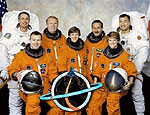
The seven-member crew of the Discovery


AP - Sun Aug 7, 4:41 AM ET The crew aboard the space shuttle Discovery gathered on the aft-flight deck to answer questions from the five major television networks in this view from television Sunday, Aug. 7, 2005. The crew from left to right back row; astronaut Andy Thomas, astronaut Charles Camarda, astronaut Wendy Lawrence and Japanese astronaut Soichi Noguchi. On the front row left to right; pilot James Kelly, commander Eileen Collins and astronaut Steve Robinson. (AP Photo/NASA TV) Email Photo Print Photo

📎 crew
Đăng nhập để trả lời
0


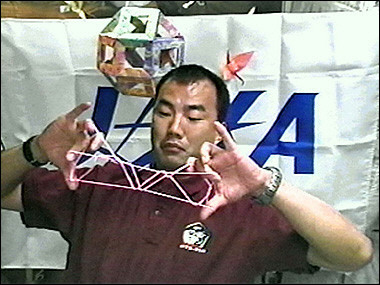
AFP/NASA-HO - Sun Aug 7, 6:01 PM ET US space shuttle Discovery Mission Specialist Soichi Noguchi of Japan shows off a string design on the shuttle's mid deck during a crew choice downlink video. Discovery is scheduled to land early 08 August 2005 at the Kennedy Space Center in Florida.(AFP/NASA-HO)

📎 Soichi
Đăng nhập để trả lời
0
<Bài viết đã được chỉnh sửa lúc 2005-08-08 11:40:36HongYen>
Astronaut Stephen K, Robinson

Reuters - Sun Aug 7, 4:27 PM ET Discovery astronauts enjoyed their final scheduled day in space on Sunday and prepared for the shuttle's fiery return to Earth's atmosphere, the anxious phase that doomed space shuttle Columbia in 2003. Astronaut Stephen K, Robinson, STS-114 mission specialist, holds a camera while floating through a hatch on the International Space Station August 5, 2005. The crew members were making final preparations for space shuttle Discovery's scheduled departure on August 6.
Photo by Nasa/Reuters

📎 Stephen
Đăng nhập để trả lời
0
Reuters - Sat Aug 6,10:55 PM ET Backdropped by the blackness of space and Earths horizon, this full view of the International Space Station was photographed by a crew member onboard the space shuttle Discovery following the undocking of the two spacecraft August 6, 2005. Discovery pulled away from the complex at 2:24 a.m. (CDT) on August 6, 2005.

📎 SpaceShuttle
Đăng nhập để trả lời
0
Three STS-114 crew members work at various tasks in the Destiny laboratory of the International Space Station while Space Shuttle Discovery was docked to the station, August 5, 2005. From the left are astronauts Stephen Robinson, Soichi Noguchi representing Japan Aerospace Exploration Agency (JAXA), both mission specialists; and pilot James Kelly[/size]. Picture taken August 5, 2005.

📎 StephenSoichi
Đăng nhập để trả lời
0
Reuters - Sat Aug 6, 8:56 PM ET Astronaut Eileen Collins, STS-114 commander, floats in the Zvezda Service Module of the International Space Station while Space Shuttle Discovery was docked to the Station, August 5, 2005. Astronaut John Phillips, Expedition 11 NASA Space Station science officer and flight engineer, is visible at bottom right. Picture taken August 5, 2005.


📎 Eileen
Đăng nhập để trả lời
0
Reuters - Sat Aug 6, 8:45 PM ET Astronauts Charles J. Camarda (L), STS-114 mission specialist, and Soichi Noguchim (R), mission specialist representing Japan Aerospace Exploration Agency (JAXA), pose for a photo in the Unity node after the STS-114 crew patch was added to the growing collection of insignias representing crews who have worked on the International Space Station, August 5, 2005. The shuttle Discovery sailed away from the International Space Station on Saturday while NASA braced for the first landing since the crew of Columbia died minutes before they were due to touch down in February 2003. Picture taken August 5, 2005.

📎 US
Đăng nhập để trả lời
0
Reuters - Sat Aug 6, 8:31 PM ET Astronaut Wendy B. Lawrence (C), STS-114 mission specialist, floats freely on the middeck of the Space Shuttle Discovery while the Shuttle was docked to the International Space Station, August 3, 2005. Astronauts James M. Kelly (L), pilot, and Charles J. Camarda, mission specialist, are visible in the background.

📎 aa
Đăng nhập để trả lời
0
Reuters - Sat Aug 6, 1:51 PM ET One of four visual aids used by Shuttle Deputy Program Manager Wayne Hale is seen during an August 4, 2005 news conference that dealt with important tests in wind tunnels at NASA's Ames Research Center. Engineers simulated the conditions of the Space Shuttle Discovery for a disrupted thermal blanket near the commanders window on the forward cabin of the spacecraft. Eventually it was decided that no additional space walk work needed to be performed to fix the blanket.

📎 blanket
Đăng nhập để trả lời
0


Andrew S. W. Thomas (Ph.D.)
NASA Astronaut

PERSONAL DATA: Born December 18, 1951, in Adelaide, South Australia. Married to Astronaut Shannon Walker. He enjoys horse riding and jumping, mountain biking, running, wind surfing, and classical guitar playing. His father, Adrian C. Thomas, resides in Hackham, South Australia. His mother, Mary E. Thomas, resides in North Adelaide, South Australia.

EDUCATION: Received a bachelor of engineering degree in mechanical engineering, with First Class Honors, from the University of Adelaide, South Australia, in 1973, and a doctorate in mechanical engineering from the University of Adelaide, South Australia, in 1978.

ORGANIZATIONS: Honorary Fellow, The Institution of Engineers Australia.

EXPERIENCE: Dr. Thomas began his professional career as a research scientist with the Lockheed Aeronautical Systems Company, Marietta, Georgia, in 1977. At that time he was responsible for experimental investigations into the control of fluid dynamic instabilities and aircraft drag. In 1980, he was appointed Principal Aerodynamic Scientist to the company and headed a research team examining various problems in advanced aerodynamics and aircraft flight test.

This was followed in 1983 by an appointment as the head of the Advanced Flight Sciences Department to lead a research department of engineers and scientists engaged in experimental and computational studies in fluid dynamics, aerodynamics and aeroacoustics. He was also manager of the research laboratory, the wind tunnels, and the test facilities used in these studies. In 1987, Dr. Thomas was named manager of Lockheed’s Flight Sciences Division and directed the technical efforts in vehicle aerodynamics, flight controls and propulsion systems that supported the company’s fleet of production aircraft.

In 1989, he moved to Pasadena, California, to join the Jet Propulsion Laboratory (JPL) and, shortly after, was appointed leader of the JPL program for microgravity materials processing in space. This NASA-sponsored research included scientific investigations, conducted in the laboratory and in low gravity on NASA’s KC-135 aircraft, as well as technology studies to support the development of the space flight hardware for future Shuttle missions.

NASA EXPERIENCE: Dr. Thomas was selected by NASA in March 1992 and reported to the Johnson Space Center in August 1992. In August 1993, following one year of training, he was appointed a member of the astronaut corps and was qualified for assignment as a mission specialist on Space Shuttle flight crews.

While awaiting space flight assignment, Dr. Thomas supported shuttle launch and landing operations as an Astronaut Support Person (ASP) at the Kennedy Space Center. He also provided technical support to the Space Shuttle Main Engine project, the Solid Rocket Motor project and the External Tank project at the Marshall Space Flight Center. In June 1995 Dr. Thomas was named as payload commander for STS-77 and flew his first flight in space on Endeavour in May 1996. He next trained at the Gagarin Cosmonaut Training Center in Star City, Russia in preparation for a long-duration flight. In 1998, he served as Board Engineer 2 aboard the Russian Space Station Mir for 130 days. Dr. Thomas completed his third space flight on STS-102 and has logged over 163 days in space. From August 2001 to November 2003, Dr. Thomas served as Deputy Chief of the Astronaut Office. Dr. Thomas is currently assigned to the crew of STS-114. He will serve as MS-3 on the Return To Flight mission during which the crew will test and evaluate new procedures for flight safety and Shuttle inspection and repair techniques. The mission is planned for launch no earlier than July 2005.

SPACE FLIGHT EXPERIENCE: STS-77 was a 10-day mission during which the crew deployed two satellites, tested a large inflatable space structure on orbit and conducted a variety of scientific experiments in a Spacehab laboratory module carried in Endeavour’s payload bay. The flight was launched from the Kennedy Space Center on May 19, 1996 and completed 160 orbits 153 nautical miles above the Earth while traveling 4.1 million miles and logging 240 hours and 39 minutes in space.

On January 22, 1998, Dr. Thomas launched aboard Space Shuttle Endeavour as part of the STS-89 crew to dock with the Mir Space Station. He served aboard Mir as Flight Engineer 2 and returned to earth with the crew of STS-91 aboard Space Shuttle Discovery on June 12, 1998, completing 141 days in space and 2,250 orbits of the earth.

STS-102 Discovery (March 8-21, 2001) was the eighth Shuttle mission to visit the International Space Station and Dr. Thomas’s third flight. Mission accomplishments included the delivery of the Expedition-2 crew and logistics resupply with the Leonardo Multi-Purpose Logistics Module, and the return to earth of the Expedition-1 crew. During the mission, Dr. Thomas performed an EVA of 6.5 hours to install components to the outside of the space station. Mission duration was 307 hours and 49 minutes.

JULY 2005
http://www.jsc.nasa.gov/Bios/htmlbios/thomas-a.html
Đăng nhập để trả lời
0
NASA Delays Discovery Landing Until Tues

AP - Mon Aug 8, 7:03 AM ET NASA public affairs officer George Diller speaks to the press at the Kennedy Space Center press site Monday, Aug. 8, 2005. After orbiting the Earth for nearly two weeks, astronauts aboard space shuttle Discovery were told to circle the planet for another day as bad weather in Florida forced NASA to delay Monday's scheduled landing.
(AP Photo/Paul Kizzle)


By PAM EASTON, Associated Press Writer
5 minutes ago

http://news.yahoo.com/news?tmpl=story&u=/ap/20050808/ap_on_sc/space_shuttle


📎 diller
Đăng nhập để trả lời
0


http://www.bbc.co.uk/vietnamese/worldnews/story/2005/08/050807_sailors_rescued.shtml
Đăng nhập để trả lời
0
Discovery to Take Another Try at Landing

By MARCIA DUNN, AP Aerospace Writer
1 hour, 45 minutes ago


CAPE CANAVERAL, Fla. - Low clouds kept shuttle Discovery and its crew of seven from making their much-anticipated return to Earth, and NASA vowed to bring the spacecraft down Tuesday in Florida, California or possibly even New Mexico.


"We will attempt to land somewhere," flight director LeRoy Cain said after Monday morning's two unsuccessful landing opportunities.

The delay disappointed the astronauts' families, who were waiting at Kennedy Space Center for their loved ones' return after nearly two stressful weeks in orbit.

Discovery's astronauts woke up Monday evening to The Beatles "Good Day Sunshine" and were ready to get back home.

"It's a day for sunshine and it's a day for feet on the ground," Mission Control radioed the astronauts.

"We sure hope we get our feet on the ground today," astronaut Wendy Lawrence responded.

It is the first shuttle flight since Columbia's catastrophic re-entry in 2003, and the mission experienced a series of problems that required emergency spacewalk repairs and constant engineering analysis.

More cloudy weather was expected at Kennedy Space Center on Tuesday with a chance of rain, but it remained NASA's first choice for an early morning touchdown. Edwards Air Force Base in California's Mojave Desert was the next choice, followed by the White Sands Missile Range in New Mexico, the absolute last resort.

Good conditions were expected at Edwards, while rain was in the forecast for White Sands.

NASA Administrator Michael Griffin insisted "there's no agony" associated with the one-day delay in getting Discovery home. Like other space agency officials, he was waiting for "wheels stop" on the runway before even thinking about celebrating.

Come Tuesday, "We're going to land one way or another, one place or another, and all we're talking about is where," Griffin said.

"It's better to be on the safe side," astronaut John Herrington observed from the runway. In fact, a thick, dark layer of clouds hovered overhead at the designated touchdown time.

Astronaut Scott Parazynski said from the landing strip that he is certain the crew members were disappointed at having to put off their family reunions. But on the other hand, "It's another day to look out the window and savor a day in space."

Indeed, some rock 'n' roll and country music drifted down over Discovery's airwaves as the astronauts settled into their extra day in space.

"Thank you for a great day off and sure looking forward to being back on solid ground," radioed astronaut Stephen Robinson, a onetime DJ.

NASA prefers landing shuttles at the same place where it launches them, to avoid the several days and estimated $1 million in ferrying the spacecraft atop a modified jumbo jet back from the West Coast.

Of the previous 111 shuttle landings, space shuttles returned 61 times to Kennedy, 49 times to Edwards and once — way back in 1982 — to White Sands. Columbia ended up coming down in a sandstorm on that third shuttle flight and, for decades, workers were still finding sand in the ship's crevices.

Discovery had enough power and supplies to stay in orbit until Wednesday, but NASA was holding out that option only if a technical problem arose that needed time to be resolved.

During the mission, the biggest setback was the loss of a 1-pound chunk of foam insulation from the fuel tank during the July 26 launch, the same problem that ended up destroying Columbia. NASA suspended future shuttle flights just one day after Discovery took off.

Two of Discovery's crew members performed three spacewalks, the first to test tools and techniques for fixing damaged heat shields, the second to replace a broken station gyroscope, and the third to remove a couple dangling strips of filler material from Discovery's belly that NASA feared could lead to a Columbia-type disaster.

___

On the Net:

NASA: http://www.nasa.gov/returntoflight/main/index.html

http://news.yahoo.com/news?tmpl=story&u=/ap/20050809/ap_on_sc/space_shuttle
Đăng nhập để trả lời
0
Discovery to Take Another Try at Landing


http://news.yahoo.com/news?tmpl=story&u=/ap/20050809/ap_on_sc/space_shuttle

📎 zero
Đăng nhập để trả lời
0
AP - Tue Aug 9, 5:51 AM ET Lt. Col. Maria Carl is seen near a display showing precipitation near Kennedy Space Center, Fla., Tuesday, Aug. 9, 2005. NASA canceled plans to land space shuttle Discovery in Florida on Tuesday because of stormy weather and told the astronauts to aim instead for a touchdown at Edwards Air Force Base in California.
(AP Photo/Paul Kizzle)

📎 Col
Đăng nhập để trả lời
0
Discovery Streaking Toward California

By ALICIA CHANG, AP Science Writer

23 minutes ago


EDWARDS AIR FORCE BASE, Calif. - Discovery and its crew of seven streaked toward a California landing Tuesday on the first shuttle re-entry since Columbia's tragic return, after thunderstorms in Florida prevented the spacecraft from returning to its home base.


The instability of the weather at Cape Canaveral, Fla., and storms popping up near the landing strip there prompted NASA to turn to its backup site in the Mojave Desert. On Monday, low clouds prevented a return to the cape.

"How do you feel about a beautiful clear night with a breeze down the runway in the high desert of California?" Mission Control radioed after giving up on Florida.

"We are ready for whatever we need to do," replied commander Eileen Collins.

With that final green light, Collins and her co-pilot, James Kelly, slowed Discovery's speed enough to drop the shuttle out of orbit about an hour before touchdown. Landing was scheduled for 5:12 a.m. PDT, well before sunrise.

The inherently dangerous ride down through the atmosphere — more anxiety-ridden than normal because of what happened to Columbia 2 1/2 years ago — was going to skip most of the continental United States this time.

Discovery was following a course that would take it over the Pacific and into Southern California. NASA officials had said they would adjust the flight path so the shuttle would skirt Los Angeles, because of new public safety considerations by NASA in the wake of the Columbia accident.

The detour to the opposite coast was a big disappointment for the astronauts' families, who had been waiting to greet their loved ones in Cape Canaveral. Their reunion was put on hold until Wednesday, when they all planned to meet in Houston.

NASA's top officials also had gathered at Cape Canaveral to welcome the crew home.

"There's nothing more that I would love to see than it here so everybody here could be a part of this. But it's not going to be," said shuttle program manager Bill Parsons. "I want it to be safe, wherever the safest place is to go."

Added Bill Readdy, an ex-astronaut who heads NASA's spaceflight office: "All you have to do is look around and see the flashes of thunder and lightning. Obviously, Mother Nature doesn't want us to land at the cape today."

With its launch on July 26, Discovery became the first shuttle to fly since Columbia's catastrophic re-entry in 2003. But its flight to the international space station could be the last for a long while.

NASA grounded the shuttle fleet after a nearly 1-pound chunk of insulating foam broke off Discovery's external fuel tank during liftoff — the very thing that doomed Columbia and was supposed to have been corrected.

Discovery spent nine days hitched to the space station, where astronauts resupplied the orbiting lab and removed broken equipment and trash — one of the main goals of the mission. That included an extra day that was added following the suspension of future flights, so the astronauts could do more work at the station. Discovery was the first shuttle to visit the orbiting outpost since 2002.

As a result of Columbia, Discovery's crew performed intense inspections of their ship on five different days. Astronauts also did a spacewalk to test new repair techniques and replaced a failed gyroscope on the station during another spacewalk.

In a third, unprecedented spacewalk, two protruding thermal tile fillers were removed from Discovery's belly. Engineers feared the material could cause dangerous overheating during re-entry.

Columbia was doomed by a 1.67-pound piece of foam that broke free from an external fuel tank at launch. The foam pierced a hole in the ship's left wing, and as the spacecraft re-entered the Earth's atmosphere on Feb. 1, 2003, searing gases melted the wing from the inside. All seven astronauts were killed.

___

On the Net:

NASA: http://www.nasa.gov/returntoflight/main/index.html

Đăng nhập để trả lời
0
Reuters - Tue Aug 9, 5:54 AM ET
Lightning is shown over television satellite trucks positioned at the Kennedy Space Center in Cape Canaveral, Florida to cover landing of the space shuttle Discovery August 9, 2005. Bad weather in the area prevented mission managers from allowing the space shuttle Discovery to return to the space center. The crew of seven is poised to complete a 14-day mission to the International Space Station. Landing opportunities are available at Edwards Air Force Base in California and at White Sands Space Harbor in New Mexico.
REUTERS/Charles W Luzier


📎 aaa
Đăng nhập để trả lời
0
Discovery Lands Safely in California
AP - 12 minutes ago
EDWARDS AIR FORCE BASE, Calif. - Discovery and its crew of seven glided safely back to Earth on Tuesday, ending a riveting, at times agonizing, 14-day test of space shuttle safety that was shadowed by the ghosts of Columbia.
Đăng nhập để trả lời
0
AP - Tue Aug 9, 8:18 AM ET In this image from NASA television, the space shuttle Discovery touches down safely on runway 22 at the Edwards Air Force Base in Calif. in this televised view Tuesday, Aug. 9, 2005. This is the 50th space shuttle landing at Edwards Air Force Base. (AP Photo/NASA TV)

📎 Di
Đăng nhập để trả lời
0
Discovery Lands Safely in California

[:D][:D][:D]
[:D][:D][:D][:D]
[:D][:D][:D][:D][:D]


By ALICIA CHANG, Associated Press Writer
15 minutes ago


EDWARDS AIR FORCE BASE, Calif. - Discovery and its crew of seven glided safely back to Earth on Tuesday, ending a riveting, at times agonizing, 14-day test of space shuttle safety that was shadowed by the ghosts of Columbia.

ADVERTISEMENT

Discovery swooped through the darkness of the Mojave Desert and landed on the Edwards runway at 5:11 a.m. PDT, well before sunrise. It marked the conclusion of the first shuttle re-entry since Columbia's tragic return.

The detour to California came after thunderstorms in Cape Canaveral, Fla., prevented the shuttle from returning to its home base.

"Congratulations on a truly spectacular test flight," Mission Control said once Discovery came to a stop. "Welcome home, friends."

"We're happy to be back and we congratulate the whole team for a job well done," Commander Eileen Collins replied.

The inherently dangerous ride down through the atmosphere — more anxiety-ridden than normal because of what happened to Columbia 2 1/2 years ago — appeared to go smoothly. No problems were immediately reported by Mission Control.

Held up a day by bad weather in Florida, the shuttle soared across the Pacific and over Southern California, passing just north of Los Angeles on its way to Edwards. NASA adjusted the flight path in order to skirt Los Angeles because of new public safety considerations in the wake of the Columbia disaster, which rained debris onto Texas and Louisiana.

Discovery's journey, which began with a liftoff on July 26, spanned 219 orbits of Earth and 5.8 million miles.

The switch to the opposite coast was a big disappointment for the astronauts' families, who had been waiting to greet their loved ones in Cape Canaveral. Their reunion was put on hold until Wednesday, when they all planned to meet in Houston.

NASA's top officials also had gathered at Cape Canaveral to welcome the crew home.

"There's nothing more that I would love to see than it here so everybody here could be a part of this. But it's not going to be," said shuttle program manager Bill Parsons. "I want it to be safe, wherever the safest place is to go."

NASA called it a test flight and it was — in an alarming way no one anticipated. A potentially deadly 1-pound chunk of foam insulation came off the redesigned fuel tank during liftoff, missing Discovery but demonstrating that the space agency had not resolved the very problem that doomed Columbia.

The foam loss prompted NASA to ground future shuttle flights.

Shuttle managers freely acknowledged the mistake, while stressing that the inspection, photography and other shuttle data-gathering systems put in place for this flight worked exceedingly well. What's more, no severe damage was detected on Discovery while it was in orbit.

A torn thermal blanket under a cockpit window was left as is, after engineers decided it posed little risk as re-entry shrapnel.

Two pieces of filler material dangling from Discovery's belly, however, were removed by a spacewalking astronaut last week, for fear they could lead to a repeat of the Columbia tragedy. The fabric strips slipped out of the narrow gaps between thermal tiles for reasons unknown.

NASA officials said a space shuttle will not fly again until the foam problem is solved and engineers understand why the two so-called gap fillers came loose.

Until the spacewalk to pull out the two protruding gap fillers, astronauts had never ventured beneath an orbiting shuttle or made repairs to its fragile thermal shielding.

"It's going to be a new beginning for the space shuttle program," NASA's spaceflight chief, Bill Readdy, said from the Cape Canaveral landing strip. "The approach that we've taken has to do with a very methodical series of flight tests. It's exactly the right approach.

"This was certainly the most documented flight in shuttle history," Readdy added.

The shuttle astronauts spent nine days at the international space station, restoring full steering capability to the orbiting outpost, delivering much-needed supplies and replacement parts, and hauling away a 2 1/2-year backlog of trash.

They successfully conducted three spacewalks, including one to test new tools and methods for fixing a damaged shuttle heat shield in orbit. They also pulled off some fancy new flying maneuvers, flipping Discovery end over end near the space station so its two residents could zoom in with cameras as part of the exhaustive search for shuttle damage.

Flight director LeRoy Cain said over the weekend that not only did NASA learn a lot about the shuttle with this mission, but "we've learned a lot about ourselves."

Following the Feb. 1, 2003, Columbia catastrophe, NASA revamped the way it managed a shuttle mission. The mission management team met daily while Discovery was in orbit, taking time to listen to dissenting opinions and encouraging them as well, according to its chairman, deputy shuttle program manager Wayne Hale. Every potential serious problem was analyzed by a team of engineers and, in the case of the ripped blanket, even prompted a series of wind tunnel tests.

Some accused the space agency of going too far to reach a group consensus and having "analysis paralysis." Shuttle officials denied that was so and said their intent was to put the astronauts' safety first no matter what, an assessment shared by Discovery's co-pilot, James Kelly.

"Just the fact that we're here means we don't have paralysis by analysis," Kelly said from orbit Sunday. "The folks on the ground have done an absolutely great job trying to take care of everything they possibly can."

___

On the Net:

NASA: http://www.nasa.gov/returntoflight/main/index.html

http://news.yahoo.com/s/ap/space_shuttle;_ylt=Aho7CoTCp3nXxniCS9oGvjwYAjMB;_ylu=X3oDMTBiMW04NW9mBHNlYwMlJVRPUCUl

Đăng nhập để trả lời
0
AP - Tue Aug 9, 8:36 AM ET

Kennedy Space Center employee Molinda Smith and other unidentified employees watch intensely as Space Shuttle Discovery lands at Edwards Air Force Base, CA. Tuesday Aug. 9, 2004. Space Shuttle Discovery and its crew of seven finished a 14 day mission that included docking with the International Space Station.

📎 ab
Đăng nhập để trả lời
0
Reuters - Tue Aug 9, 8:37 AM ET

The shuttle Discovery is seen before touchdown on the runway at 7:11am CDT in this view from an infra-red camera after a sucessful re-entry, at Edwards Air Force base in California August 9, 2005. Discovery and its seven astronauts returned to Earth safely on Tuesday, bringing a successful end to NASA's troubled return to human spaceflight 2 1/2 years after the destruction of sister ship Columbia.
Đăng nhập để trả lời
0
The shuttle Discovery is seen before touchdown on the runway at 7:11am CDT


📎 abc
Đăng nhập để trả lời
0
Reuters - Tue Aug 9, 8:42 AM ET The shuttle Discovery sits on the runway in this view from an infra-red camera after a sucessful re-entry, at Edwards Air Force base in California August 9, 2005. Discovery and its seven astronauts returned to Earth safely on Tuesday, bringing a successful end to NASA's troubled return to human spaceflight 2 1/2 years after the destruction of sister ship Columbia. EDITORIAL USE ONLY REUTERS/NASA TV Email Photo Print Photo

📎 aa
Đăng nhập để trả lời
0
AP - Tue Aug 9, 8:42 AM ET Kennedy Space Center employees clap as Space Shuttle Discovery touches down at Edwards Airforce Base, CA. Tuesday Aug. 9, 2005. Space Shuttle Discovery and a crew of seven were in space for 14 days on a mission that included docking with the International Space Station. (AP Photo/Terry Renna)

📎 a
Đăng nhập để trả lời
0
«« « 1 2 3 4 5 » »»